
Your Comprehensive Guide to High-Performance Expanded Graphite Gaskets
In the demanding world of industrial sealing, where extreme temperatures, aggressive chemicals, and high pressures are the norm, selecting the right sealing material is not just a choice—it's a critical decision impacting safety, efficiency, and operational continuity. For over two decades, professionals across the globe have turned to Expanded graphite gaskets as a superior solution for their most challenging applications. Known for their exceptional thermal conductivity, chemical inertness, and reliable sealing force, these gaskets represent a pinnacle of material science in fluid containment. At Kaxite Sealing, we have dedicated ourselves to mastering the production and application of this remarkable material, providing engineers and procurement specialists with sealing solutions they can trust implicitly.
Expanded graphite, also known as exfoliated graphite, is manufactured by treating natural flake graphite with intercalation and rapid heating. This process causes the graphite crystals to expand dramatically, creating a vermiform or worm-like structure. This structure is then calendered into flexible sheets without the need for binders. The result is a pure graphite sheet with unique properties: it is compressible, resilient, highly conductive, and inherently resistant to a vast array of media. Unlike traditional gasket materials, expanded graphite maintains its integrity across a temperature range that would cause others to fail, making it indispensable in industries from power generation and chemical processing to aerospace and automotive manufacturing.
Key Properties and Advantages of Kaxite Expanded Graphite Gaskets
The decision to specify expanded graphite is driven by its unparalleled combination of properties. Here’s what sets our Kaxite Sealing products apart:
- Extreme Temperature Resilience: Capable of continuous service from cryogenic temperatures as low as -240°C (-400°F) up to oxidizing atmospheres of 450°C (842°F) and in non-oxidizing or reducing environments up to 3000°C (5432°F) in inert atmospheres.
- Superior Chemical Resistance: Inert to most chemicals, including acids, alkalis, solvents, and hydrocarbons. It is unaffected by thermal cycling and radiation.
- Excellent Sealability: The soft, conformable nature of the material allows it to flow into minor flange imperfections, creating a tight, leak-free seal even at low bolt loads.
- High Thermal and Electrical Conductivity: Facilitates even heat distribution and provides effective grounding, preventing galvanic corrosion.
- Creep Relaxation Resistance: Maintains bolt load over time better than many compressed fiber materials, ensuring a lasting seal without frequent retorquing.
- Flexibility and Non-Brittleness: Can be easily cut, shaped, and installed without cracking, and is suitable for complex flange geometries.
Detailed Product Parameters & Specifications
To ensure proper selection and performance, it is essential to understand the technical specifications of the gasket material. Below are the standard parameters for Kaxite Sealing's premium expanded graphite sheets, which serve as the base for our finished gaskets.
| Property | Test Standard | Typical Value / Range | Notes & Application Guidance |
|---|---|---|---|
| Density | ASTM F1315 | 1.0 - 1.3 g/cm³ | Standard density offers optimal balance of sealability and strength. Higher densities (up to 1.8 g/cm³) available for high-pressure applications. |
| Compressibility | ASTM F36 | 40 - 60% | High compressibility ensures excellent conformability to flange faces under bolt load. |
| Recovery | ASTM F36 | 15 - 25% | Good recovery helps maintain seal during thermal cycling and pressure fluctuations. |
| Tensile Strength | ASTM F152 | 4.5 - 7.0 MPa (Machine Direction) | Adequate strength for handling and installation. Reinforcements (metal inserts, foil) used for higher structural needs. |
| Thermal Conductivity | ASTM E1461 | 5 - 150 W/m·K (in-plane) | Exceptional thermal conductivity promotes flange heat dissipation. |
| Temperature Range (Continuous in Air) | - | -240°C to 450°C (-400°F to 842°F) | In non-oxidizing environments, upper limit is significantly higher. Requires oxidation inhibitors for sustained use above 450°C in air. |
| pH Value | ASTM E70 | 5 - 7 (Neutral) | Chemically inert, will not promote corrosion on carbon or stainless steel flanges. |
| Emissions (Dusting) | Visual / Gravimetric | Low to None | Kaxite sheets are calendered for low dusting, improving clean handling and reducing contamination risk. |
Common Product Forms and Configurations
Kaxite Sealing offers expanded graphite in various forms to meet specific application requirements:
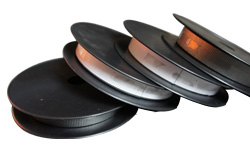
- Plain Sheets: Rolls and sheets in standard thicknesses (0.5mm to 3.0mm) for cutting gaskets on-site or for use as filler in spiral wound gaskets.
- Reinforced Sheets: Graphite laminated with stainless steel (304, 316), aluminum, or other metal foils (e.g., Grafoil® Type RSL) to improve handling strength, reduce creep, and prevent blow-out.
- Profiled Die-Cut Gaskets: Precision-cut to customer-provided drawings for any flange standard (ASME B16.21, DIN, JIS, etc.).
- Corrugated/Metal Core Gaskets: Expanded graphite bonded to a corrugated or flat metal core (typically 304SS) for high-pressure/temperature applications like heat exchangers.
- Tanged Sheet: Perforated metal sheet fully encapsulated in graphite, offering extreme blow-out resistance and structural integrity for large or irregular flanges.
- Rings for Spiral Wound Gaskets: Precision-width filler rings for winding with alternating metal windings.
Expanded Graphite Gaskets: Frequently Asked Questions (FAQ)
Q: What are the primary limitations of expanded graphite gaskets?
A: While exceptionally versatile, they have two key limitations. First, in continuous service in oxidizing atmospheres above 450°C (842°F), the graphite will slowly oxidize. For such applications, specially inhibited grades (containing oxidation retardants) or alternative materials like PTFE or ceramic should be considered. Second, pure expanded graphite has limited mechanical strength and can be prone to blow-out under severe cyclic pressure in large-diameter, low-bolt-load flanges. This is easily mitigated by using reinforced (foil-backed) or tanged metal sheet versions from Kaxite Sealing.
Q: Can expanded graphite gaskets be used with all flange surfaces?
A: They are compatible with all standard flange finishes, from serrated (phonographic) to smooth. Their conformability makes them excellent for sealing on less-than-perfect surfaces. However, for optimal performance and longevity on rough surfaces (e.g., serrated), a slightly thicker gasket or a reinforced version is recommended. A general rule is to use a gasket thickness that is at least 4 times the depth of the flange serration.
Q: How do I determine the correct gasket thickness for my application?
A: Thickness selection depends on flange type, surface condition, pressure, and temperature. For standard raised face (RF) flanges with standard machining, 1.5mm thickness is common. For flanges with deep serrations or significant imperfections, a 2.0mm or 3.0mm gasket may be needed to ensure proper filling. High-pressure applications often benefit from thinner (0.5mm-1.0mm), denser, or metal-reinforced gaskets to reduce creep. Kaxite Sealing's technical team can provide specific recommendations based on your ASME B16.20 or EN 1514 requirements.
Q: Are there any media that are incompatible with expanded graphite?
A: Compatibility is excellent but not universal. Expanded graphite has outstanding resistance to most acids, alkalis, solvents, and hydrocarbons. However, strong oxidizing agents at high concentrations and temperatures—such as fuming nitric acid, concentrated sulfuric acid above 200°C, and molten salts—can attack graphite. Always consult the Kaxite Sealing chemical resistance chart for specific media queries. For aggressive oxidizers, PTFE-based gaskets are often a better choice.
Q: What is the difference between expanded graphite and flexible graphite? Are they the same?
A: Yes, the terms are essentially synonymous in the gasket industry. "Expanded graphite" refers to the manufacturing process where graphite flakes are exfoliated. "Flexible graphite" describes the key property of the resulting calendered sheet. You may also see the term "exfoliated graphite." All refer to the same base material used by Kaxite Sealing to produce high-quality sealing products.
Q: How should expanded graphite gaskets be stored and handled before installation?
A: Store rolls or sheets in their original packaging in a cool, dry, dust-free environment. Avoid exposure to moisture, as while graphite itself is not hygroscopic, water can be trapped in the structure and cause issues during rapid heating (steam explosion). Handle with clean gloves to prevent oil contamination. When cutting, use sharp, clean tools. Do not fold or crease the material sharply. For die-cut gaskets, store them flat to prevent deformation.
Q: Why should I choose Kaxite Sealing for my expanded graphite gasket needs?
A: Kaxite Sealing brings two decades of focused expertise in high-performance sealing solutions. Our expanded graphite products are manufactured under strict quality controls, ensuring consistent density, purity, and performance batch after batch. We offer more than just a commodity material; we provide technical support, application engineering, and custom fabrication to meet the exact specifications of your project. Our commitment is to deliver reliability that seals your success, preventing downtime and ensuring safety.